Gold trade discrepancies expose regulatory failures, political interference
Business
Finance
Politics
November 29, 2026
Share this article
Click to view full size
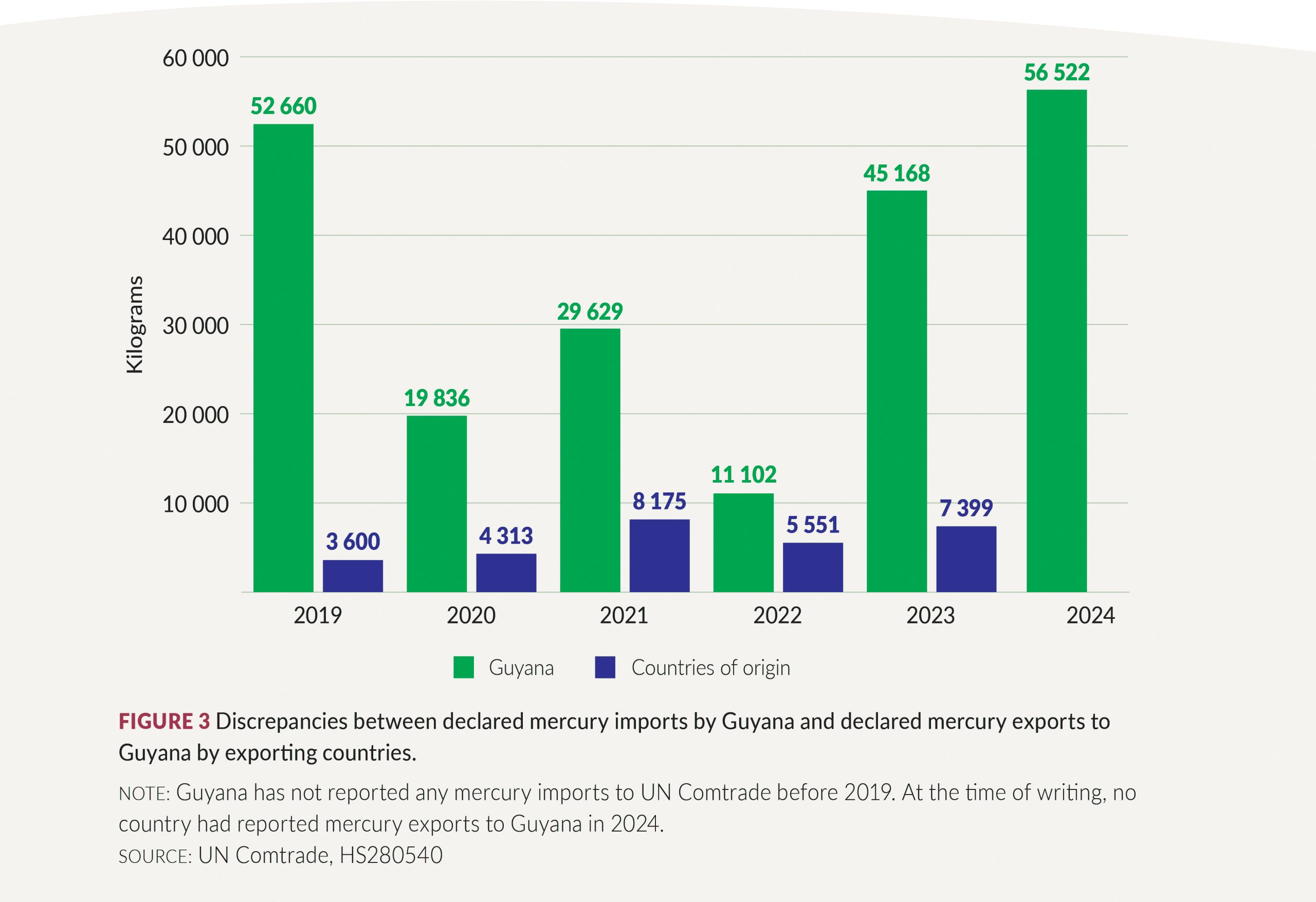
(Kaieteur News) – A November 2026 investigation by the Global Initiative Against Transnational Organized Crime and SWISSAID reveals sharp mismatches between trade figures declared by Guyana and figures reported by partner countries, alongside domestic reporting gaps that obscure true mining output and cross-border flows. While Guyana’s declared exports of unwrought or semi-manufactured gold fell from 19.8 tonnes in 2019 to 13.5 tonnes in 2024, with 6,080 kilograms declared in the first half of 2025, mirror trade comparisons with international customs records, industry datasets and mercury trade figures show substantial divergences across specific years and jurisdictions. As the report warns, “licit and illicit gold are regularly co-mingled along supply chains, particularly in trading hubs, obscuring origins and circumstances of trade before the gold enters formal channels”.
Those export and declaration mismatches unfold against domestic governance vulnerabilities, including concentrated mining claims, political claims around declaration targets and weak regulatory oversight. Data on licences held at 1 January 2023 show that “five individuals held over 65 per cent of the total surface area of all mining claims” in 2023, while Guyana Extractive Industries Transparency Initiative figures show the five largest claim holders held over 30 per cent of listed claims and the five largest holders of gold mining permits held just under 20 per cent of the total surface area of permitted mines. Alongside the Guyana Geology and Mines Commission warning in 2024 that gold must be sold only to the Gold Board or licensed dealers on pain of prosecution, Nazar Mohamed later alleged that a senior minister and a permanent secretary had nonetheless asked him and his son to declare gold to boost the 2024 figures. Observers and officials also pointed to deep industry sway and lax enforcement at the commission, with one mining authority remarking that “‘GGDMA control everything'” and another observer warning that “‘Miners are basically free to do as they please'” amid paper-based tracking, outdated public mineral tenure data last updated in 2022 and omitting small-scale mining data, and audits lagging behind.
Researchers examining Guyana’s official trade statistics found major limitations and anomalies that complicate efforts to track export volumes and destinations. Comparing Bank of Guyana statistics with United Nations Comtrade data revealed unexplained discrepancies in both weights and values even though both draw on Bureau of Statistics reporting, including totals on UN Comtrade between 2020 and 2022 that appeared to be “exactly twice the Bank of Guyana figures” anomalies the Bureau of Statistics confirmed on 5 February 2026 it had asked the UN Statistics Division to correct, though they remained uncorrected as of March 2026. Guyana Gold Board export records were publicly available only for 2020 through 2023, with 2024 and 2025 data unavailable as of June 2026, omitted large-scale mining gold for 2023, and listed foreign buyers’ addresses rather than final destination countries. To overcome those gaps, researchers combined Guyanese Bureau of Statistics destination data, UN Comtrade mirror data under customs code HS 7108, and London Bullion Market Association Country of Origin Data, while noting that mirror data in the report included 2024 gold imports from Guyana into the United Arab Emirates that “disappeared from UN Comtrade in November 2025”.
Read the full story
Continues on Kaieteur News
Business
Finance
Politics
Share
Need the bigger picture?
Comments (0)
Download our mobile app
The portable companion to gazettE. Get notifications, track read articles, and more. The latest news from Trinidad and Tobago, in one place.