Nicole Carr visits Jamaica to reclaim family history through new book
Health
July 17, 2026
Share this article
Click to view full size
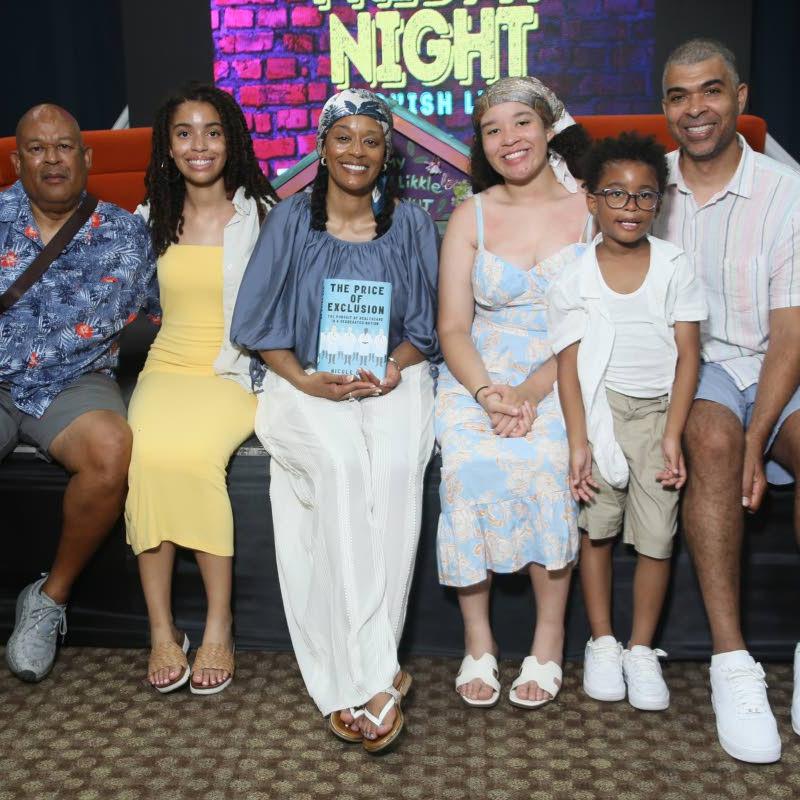
Award-winning journalist and author Nicole Carr said much of the foundation of her book, The Price of Exclusion: The Pursuit of Healthcare in a Segregated Nation, was uncovered through research and credited Jamaican resources with helping her gather the relevant information. Through the process, she also discovered new details about her own family’s history and its connection to the healthcare sector.“I had to bring this book back to Jamaica because it wasn’t possible without Jamaica,” Carr, who was a featured author at the Book Fairy Festival, said. “This was such a special experience to share with my father, who was reared in Port Antonio ... I had a chance to teach my family something about us that we didn’t know.”Her research took her to the Jamaica Archives and Records Department, the National Library of Jamaica, Gleaner Library and Port Antonio itself, where she pieced together parts of her family’s history that had been lost over generations.The Price of Exclusion traces a century of black medical history through the lives of black physicians, with much focus on her ancestor, Dr Lawrence St Clair Ferguson, a Jamaican-born physician who spent much of his career overseeing the hospital in Port Antonio. Inspired by questions raised during the COVID-19 pandemic, Carr’s search evolved into a broader examination of black healthcare, representation in medicine and the shared histories of the African diaspora.“I also hope that people get from this book that they understand the impact of anti-blackness around the globe,” she told The Gleaner. “Too often we’re in these diaspora wars where we don’t even understand the ways in which our histories intersect.”Those stories, Carr believes, are best told by those whose histories they represent. She added that reclaiming those histories is a responsibility to future generations as well as an act of remembrance. “It’s on us to educate and actually reclaim histories. It’s on us to do that, not only for ourselves, but for our ancestors and for our descendants, those who are yet to come.”A work of non-fiction, Carr hopes The Price of Exclusion reaches readers who might not typically gravitate towards history books. Discussing the reception of her book thus far, Carr said, “I’ve had people who say, ‘I don’t read non-fiction, but this reads like a novel to me’”. She also hopes younger readers, in particular, will be encouraged to seek to understand their history beyond technology. “We start looking for artificial intelligence instead of ancestral intelligence,” she said. “I hope this reaches readers who say, ‘I didn’t know this before I read this book.’”Drawing from her own investigative journalism career, Carr also shared the importance of journalists in preserving history, as archival reporting was an invaluable resource while researching her latest book.“I couldn’t have written this book without journalists, without the historic black press and The Gleaner press,” she said. “If we don’t have the people around to curate or author the first draft of history, then we’re lost.”As an investigative journalist, professor and author, Carr said the same principle guides both forms of storytelling. “At the core of any good book or any good report is people,” she said. “Showing us the human face and the human toll of those facts and figures is what brings the story to life.”
ruth-ann.briscoe@gleanerjm.com
Health
Need the bigger picture?
Share this article
Comments (0)
Download our mobile app
The portable companion to gazettE. Get notifications, track read articles, and more. The latest news from Trinidad and Tobago, in one place.